
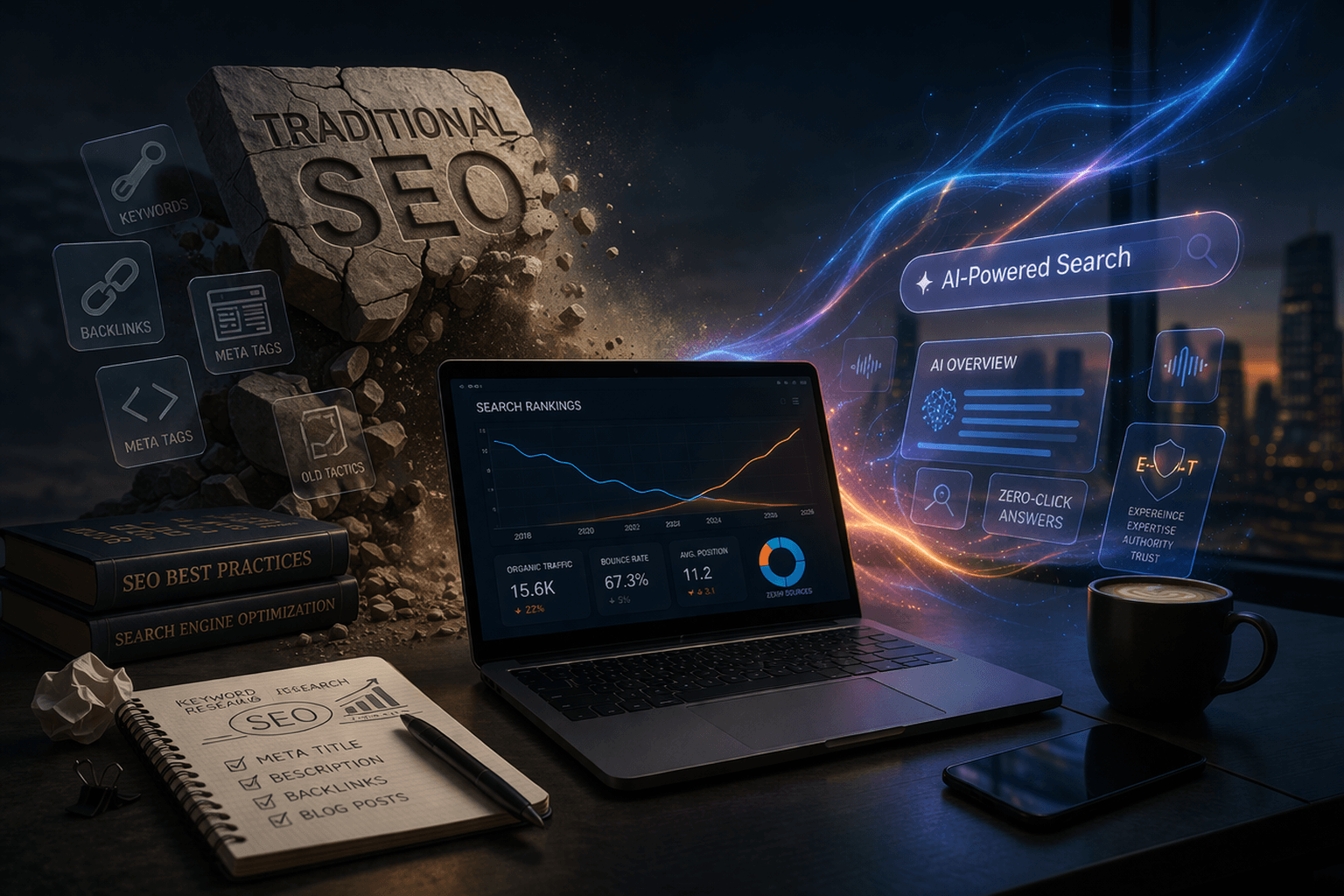
Search Engine Optimization (SEO) has long been considered the backbone of digital visibility. But with AI-powered search engines, changing user behavior, and evolving algorithms, many marketers are asking: Is traditional SEO dying—or just transforming?
In this blog, we explore whether the decline of traditional SEO is a genuine shift or simply industry hype, and what businesses like SaaS brands, startups, and enterprises should do next to stay competitive.
Table of Contents
- What Is Traditional SEO?
- Why People Say Traditional SEO Is Declining
- The Role of AI in Changing Search Behavior
- Google’s Algorithm Evolution and Its Impact
- Zero-Click Searches: The Silent Traffic Killer
- Content Overload and the End of Keyword Stuffing
- Rise of Experience-Driven SEO (E-E-A-T)
- Why SEO Is Not Dead—Just Evolving
- The Future of SEO: What Marketers Should Focus On
- How Digilancers Helps Businesses Adapt to Modern SEO
- Final Verdict: Decline or Transformation?
The Decline of Traditional SEO: Reality or Industry Hype?
For over two decades, SEO has been one of the most reliable digital marketing strategies for businesses aiming to increase visibility, attract traffic, and generate leads organically. However, the digital landscape is changing rapidly. AI-powered search results, voice assistants, zero-click searches, and evolving ranking algorithms are reshaping how users interact with search engines.
This shift has sparked debate across the marketing world: Is traditional SEO losing its relevance? Or is it simply entering a new phase of evolution?
Let’s explore what’s really happening.
What Is Traditional SEO?
Traditional SEO refers to optimization techniques that primarily focused on improving search rankings through:
- Keyword optimization
- Backlink building
- Meta tags and descriptions
- Technical site structure
- On-page optimization
- Blog publishing for ranking keywords
For years, ranking on Page 1 of Google meant predictable traffic growth. Businesses invested heavily in keyword-based content strategies to capture search demand.
But today, that formula alone no longer guarantees results.
Why People Say Traditional SEO Is Declining
Several industry trends have contributed to the perception that SEO is becoming less effective.
1. AI-Powered Search Results
Search engines now provide direct answers within results pages using AI-generated summaries. Users often find what they need without clicking any website link.
This reduces organic traffic—even for top-ranking pages.
2. Increasing Competition Across Industries
Every company today is publishing blogs.
What used to be a low-competition strategy has now become saturated. Ranking for high-value keywords requires significantly more authority and expertise than before.
3. Shift Toward Multi-Channel Discovery
Users no longer rely only on Google. They search on:
- YouTube
- Amazon
- ChatGPT-style AI assistants
This decentralization reduces dependence on traditional search engines.
The Role of AI in Changing Search Behavior
AI tools are transforming how people discover information.
Instead of searching:
“Best CRM software for startups”
Users now ask:
“Which CRM is best for early-stage SaaS companies under $50/month?”
AI assistants generate summarized answers instantly, reducing the need to visit multiple websites.
This shift challenges keyword-driven SEO strategies.
However, it also creates new opportunities for authority-based content optimization.
Google’s Algorithm Evolution and Its Impact
Google’s ranking systems have evolved dramatically over the past decade.
Major updates now prioritize:
- Content authenticity
- User experience
- Expertise signals
- Author credibility
- Helpful content frameworks
Earlier SEO tactics like backlink farming and keyword stuffing are no longer effective—and can even harm rankings.
Today, Google rewards trustworthy brands over optimized pages.
Zero-Click Searches: The Silent Traffic Killer
A growing percentage of searches now end without clicks.
Examples include:
- Featured snippets
- Knowledge panels
- AI summaries
- Local packs
- “People Also Ask” results
Users get answers instantly, reducing website visits.
This has changed how marketers measure SEO success.
Ranking alone is no longer enough.
Visibility across search features matters more than ever.
Content Overload and the End of Keyword Stuffing
Publishing large volumes of keyword-targeted articles used to work well.
Not anymore.
Today’s algorithms detect:
- Low-value repetition
- Thin content
- AI-generated spam
- Duplicate topic coverage
Instead, search engines reward:
- original insights
- expert analysis
- structured explanations
- real-world examples
Quality has replaced quantity.
Rise of Experience-Driven SEO (E-E-A-T)
Google now evaluates content using the E-E-A-T framework:
Experience
Expertise
Authoritativeness
Trustworthiness
This shift signals a move away from anonymous keyword blogs toward expert-led knowledge content.
For example:
A medical article written by a certified doctor ranks higher than generic health advice.
Similarly, SaaS strategy articles written by practitioners outperform outsourced keyword blogs.
This represents a major evolution—not a decline—in SEO strategy.
Why SEO Is Not Dead—Just Evolving
Despite industry concerns, SEO remains one of the highest ROI digital channels.
However, the strategy has shifted from:
Keyword targeting → Authority building
Traffic chasing → Intent matching
Ranking pages → Building brands
Modern SEO integrates:
- content strategy
- technical optimization
- UX signals
- topical authority
- brand trust
Businesses that adapt continue to see strong results.
Those using outdated tactics struggle.
The Future of SEO: What Marketers Should Focus On
Instead of abandoning SEO, smart organizations are evolving their approach.
Here’s what works in 2026 and beyond:
1. Topic Clusters Instead of Keywords
Search engines now evaluate subject expertise across multiple related articles rather than isolated keyword pages.
Build knowledge hubs—not standalone posts.
2. Search Intent Optimization
Understanding why users search matters more than matching exact phrases.
Intent-driven content performs significantly better than keyword-driven writing.
3. AI + Human Hybrid Content Strategy
AI accelerates research and structure.
Human expertise delivers originality and authority.
The combination creates high-performing content ecosystems.
4. Technical SEO Still Matters
Fast-loading websites, structured schema markup, and mobile responsiveness remain essential ranking factors.
Technical performance supports content visibility.
5. Brand Signals Are the New Backlinks
Search engines increasingly evaluate:
- brand mentions
- community engagement
- social presence
- author credibility
Strong brands rank faster than unknown websites.
How Digilancers Helps Businesses Adapt to Modern SEO
At Digilancers, we believe SEO is not disappearing—it’s transforming into a smarter, authority-driven growth engine.
Our approach focuses on:
✅ Intent-based content architecture
✅ SaaS-focused keyword ecosystems
✅ AI-assisted research with expert validation
✅ Technical SEO optimization
✅ Conversion-driven landing page strategy
✅ Multi-channel search visibility
Instead of chasing outdated ranking tricks, we help businesses build sustainable organic growth frameworks.
Final Verdict: Decline or Transformation?
So, is traditional SEO declining?
Yes—if defined as keyword stuffing, backlink manipulation, and mass blog publishing.
No—if defined as strategic search visibility driven by authority, expertise, and user value.
SEO is not dying.
It is evolving into Search Experience Optimization.
Brands that adapt early will dominate organic discovery in the AI-powered search era.
Businesses that continue relying on outdated playbooks risk disappearing from search results altogether.
The future belongs to organizations that treat SEO not as a checklist—but as a long-term visibility strategy.

