
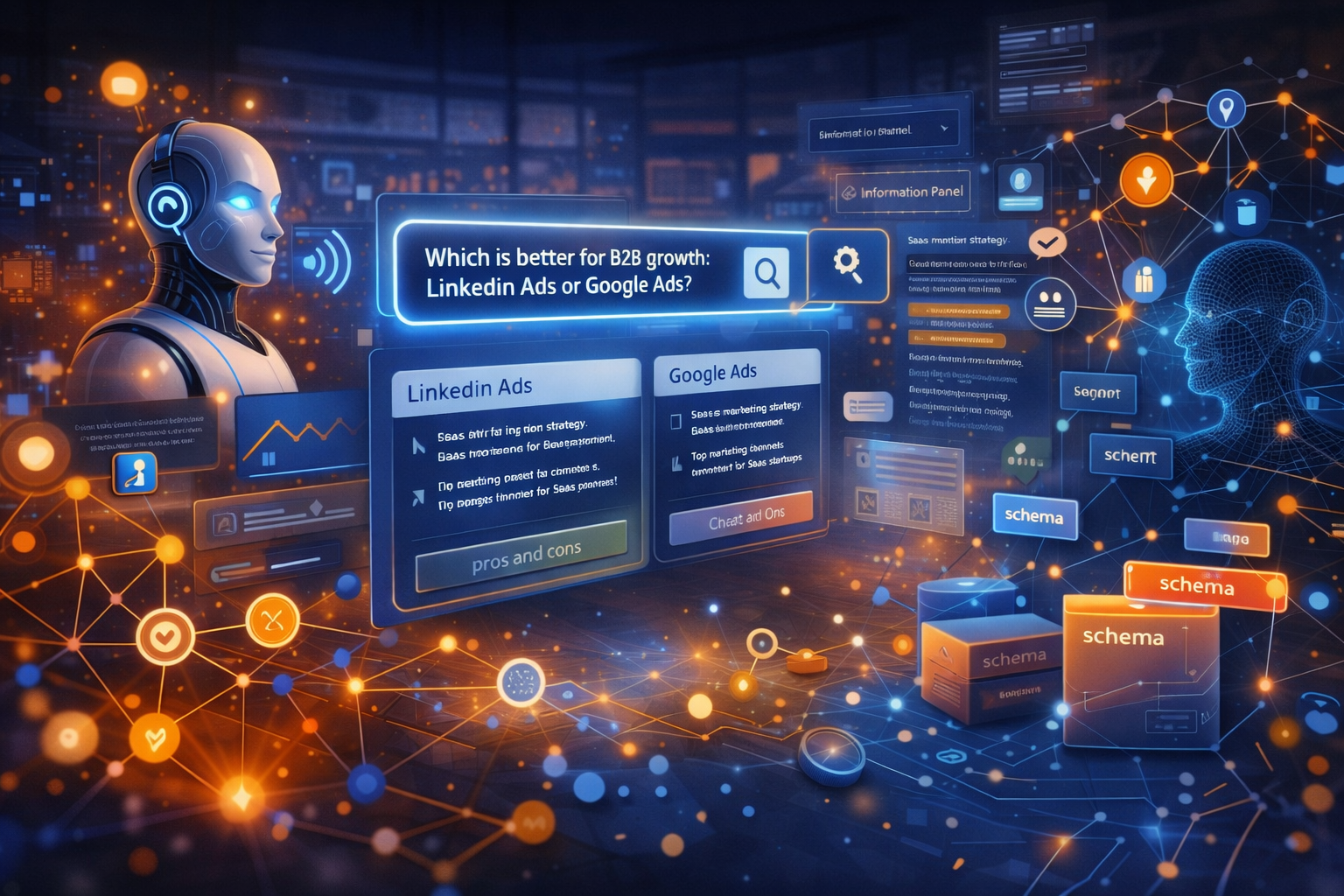
Answer Engine Optimization (AEO) is rapidly becoming the next evolution of SEO as AI-powered search assistants reshape how users discover information online. In 2026, ranking on search engines alone is no longer enough—brands must optimize to become the answer itself across platforms like AI chat assistants, voice search tools, and generative search experiences. Businesses that adapt early will gain a decisive visibility advantage in the new search ecosystem.
This guide from Digilancers explains how Answer Engine Optimization works, why it matters in 2026, and how SaaS companies, startups, and digital brands can build future-ready AI search strategies.
Table of Contents
- What is Answer Engine Optimization (AEO)?
- Why AEO Matters More Than SEO in 2026
- How AI Search is Changing User Behavior
- Key Differences Between SEO and AEO
- Core Ranking Factors for AI Answer Engines
- Structured Content Strategies for AEO
- Role of E-E-A-T in AI Visibility
- Optimizing for Voice and Conversational Queries
- Schema Markup and Knowledge Graph Optimization
- AEO for SaaS Companies and B2B Brands
- Content Formats That Perform Best in AI Search
- Measuring AEO Performance in 2026
- Common AEO Mistakes to Avoid
- Future of Answer Engine Optimization
- How Digilancers Helps Brands Win AI Search
What is Answer Engine Optimization (AEO)?
Answer Engine Optimization (AEO) is the process of structuring content so AI-powered search systems can directly extract, understand, and present your information as answers to user queries.
Unlike traditional SEO—which focuses on ranking web pages—AEO focuses on becoming the trusted source cited by AI assistants such as:
- Chat-based search engines
- Voice assistants
- Generative search experiences
- Smart enterprise copilots
- Knowledge panels and featured snippets
In simple terms:
SEO helps users find your website.
AEO helps AI deliver your content as the answer.
Why AEO Matters More Than SEO in 2026
Search behavior has shifted dramatically. Users increasingly expect:
- instant answers
- summarized responses
- conversational explanations
- voice interaction
- AI-curated recommendations
Instead of browsing ten links, users now ask:
“Best performance marketing strategy for SaaS startups in 2026?”
AI tools respond with synthesized answers—not link lists.
If your brand is not optimized for AEO, it becomes invisible in these responses.
Businesses adopting AEO early benefit from:
- higher authority perception
- stronger brand recall
- increased zero-click visibility
- improved trust signals
- long-term organic dominance
How AI Search is Changing User Behavior
Search engines are evolving into answer engines.
Major behavioral shifts include:
Conversational Queries
Users now search naturally:
“Which performance marketing channels work best for SaaS companies?”
instead of:
“SaaS marketing channels 2026”
Zero-Click Results
Users get answers directly without visiting websites.
Multi-Step Intent Queries
Example:
“Compare Google Ads vs LinkedIn Ads for B2B SaaS growth”
AI delivers structured comparisons instantly.
Trust-Based Selection
Users rely on AI-curated recommendations instead of browsing multiple sources.
This is why AEO is becoming essential.
Key Differences Between SEO and AEO
| Factor | SEO | AEO |
| Goal | Rank webpages | Become the answer |
| Focus | Keywords | Intent |
| Format | Articles | Structured responses |
| Optimization | Metadata | Context clarity |
| Target | Search engines | AI assistants |
| Outcome | Click traffic | Authority visibility |
Winning in 2026 requires combining both strategies.
Core Ranking Factors for AI Answer Engines
AI answer engines prioritize content differently from traditional search algorithms.
Important signals include:
Context Clarity
Content must clearly answer a specific question.
Example:
Bad: “Performance marketing improves conversions.”
Good: “Performance marketing improves SaaS conversions by optimizing paid acquisition through measurable ROI campaigns.”
Structured Formatting
AI prefers:
- bullet points
- tables
- definitions
- summaries
- step-by-step explanations
Semantic Depth
Content should cover related subtopics thoroughly.
Example:
Instead of writing about “Google Ads strategy,” include:
- targeting
- bidding
- funnel stages
- attribution
- automation
Authority Signals
AI models prioritize expert-backed content.
Include:
- frameworks
- data insights
- real-world strategies
- experience-driven recommendations
Structured Content Strategies for AEO
To rank in AI answers, content must be modular and extractable.
Use:
Direct Question Headings
Example:
“What is Answer Engine Optimization?”
Definition Blocks
Provide concise 2–3 sentence answers immediately after headings.
Step-by-Step Frameworks
Example:
“How to build an AEO strategy in 2026”
Comparison Tables
AI frequently surfaces comparison data.
Summary Sections
Helpful for voice assistants and featured responses.
Role of E-E-A-T in AI Visibility
E-E-A-T stands for:
- Experience
- Expertise
- Authoritativeness
- Trustworthiness
In 2026, AI systems heavily prioritize these signals.
Ways to improve E-E-A-T:
- publish original insights
- include expert commentary
- cite real strategies
- share case-based learning
- maintain topical consistency
Brands that demonstrate experience rank more frequently in AI-generated answers.
Optimizing for Voice and Conversational Queries
Voice search continues to grow rapidly across mobile and smart devices.
Voice queries are typically:
- longer
- conversational
- intent-driven
Example:
Typed search:
“best SaaS marketing strategy”
Voice search:
“What is the best marketing strategy for SaaS startups with limited budget?”
To optimize:
- write natural-language responses
- answer follow-up questions
- include FAQ sections
- avoid robotic keyword stuffing
Schema Markup and Knowledge Graph Optimization
Structured data helps AI understand your content faster.
Important schema types include:
- FAQ schema
- How-to schema
- Article schema
- Organization schema
- Product schema
Schema improves chances of appearing in:
- featured snippets
- AI summaries
- voice responses
- knowledge panels
Knowledge graph presence also strengthens brand authority signals.
AEO for SaaS Companies and B2B Brands
AEO is especially powerful for SaaS businesses because buyers rely heavily on research-driven decisions.
Winning strategies include:
Educational Content Clusters
Example:
“Customer acquisition strategies for SaaS”
supported by:
- funnel optimization
- paid acquisition
- retention frameworks
- onboarding strategy
Problem-Solution Articles
Example:
“How to reduce SaaS churn in 90 days”
Decision Comparison Content
Example:
“HubSpot vs Salesforce for startups”
AI frequently extracts comparison summaries.
Content Formats That Perform Best in AI Search
Certain formats consistently rank better in answer engines.
Top-performing structures:
Definition Posts
Example:
“What is performance marketing?”
Step-by-Step Guides
Example:
“How to scale SaaS acquisition using Google Ads”
Comparison Articles
Example:
“SEO vs Performance Marketing”
Strategy Frameworks
Example:
“Full-funnel SaaS growth playbook”
FAQs
AI assistants frequently extract FAQ responses.
Measuring AEO Performance in 2026
Traditional SEO metrics are no longer enough.
New success indicators include:
AI Citation Frequency
How often your brand appears in AI responses.
Featured Answer Visibility
Presence in summaries and snippets.
Voice Search Inclusion
Whether assistants reference your content.
Entity Authority Growth
Brand recognition within knowledge graphs.
Zero-Click Impression Share
Exposure without page visits.
These metrics reflect true AI-era visibility.
Common AEO Mistakes to Avoid
Many brands fail at AEO because they still rely only on traditional SEO tactics.
Avoid:
Keyword Stuffing
AI prioritizes meaning—not repetition.
Long Intro Sections Without Answers
Always provide immediate responses.
Weak Content Structure
Poor formatting reduces extractability.
Generic Content
Original insight ranks higher.
Ignoring Conversational Queries
Modern search is dialogue-based.
Future of Answer Engine Optimization
AEO will define digital visibility for the next decade.
Emerging trends include:
- AI-first indexing models
- conversational search dominance
- predictive intent-based answers
- personalized knowledge responses
- multimodal search integration
Soon, ranking on Google alone will not guarantee discoverability.
Brands must optimize for AI ecosystems, not just search engines.
How Digilancers Helps Brands Win AI Search
At Digilancers, we help SaaS companies and digital brands transition from traditional SEO to future-ready Answer Engine Optimization strategies.
Our AEO services include:
- AI search visibility audits
- structured content frameworks
- schema implementation
- authority-building strategies
- conversational keyword mapping
- performance marketing integration
By combining SEO, performance marketing, and AI visibility engineering, we position brands to become trusted sources across next-generation search platforms.
In 2026, the brands that win search are the brands that become answers.

